Catalogue

What is your catalogue actually worth?

Model it here — annual streams, US or LATAM royalty rates, and the differentiators that move the multiple. Then read the book that explains what a buyer is really underwriting.

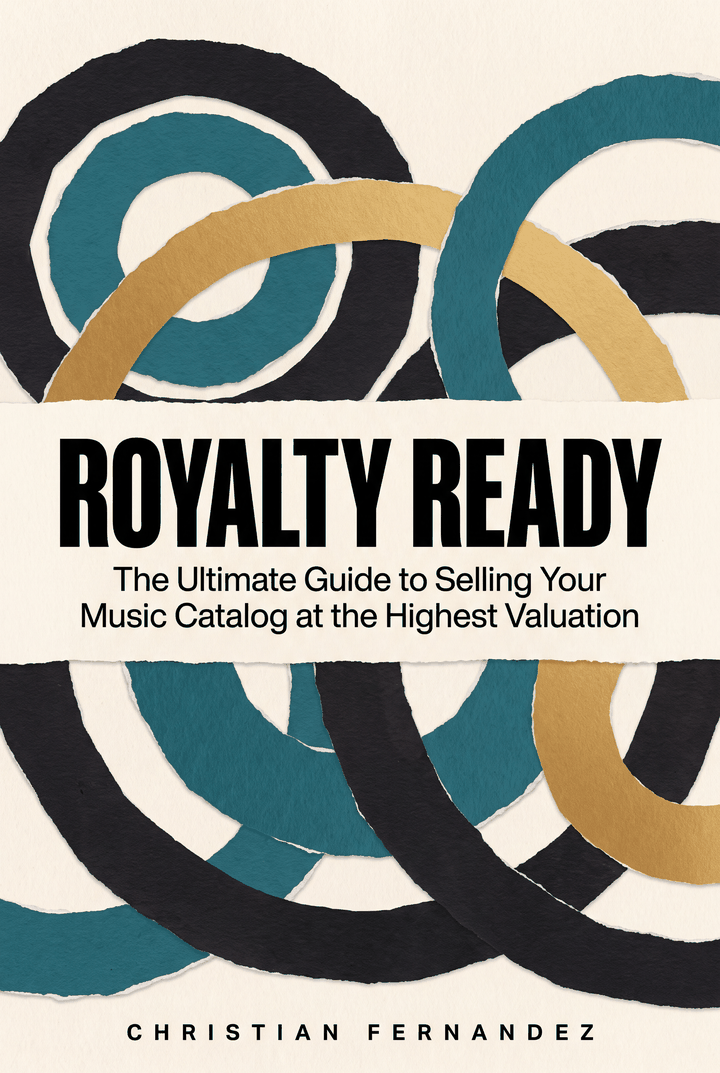
Royalty Ready — The Ultimate Guide to Selling Your Music Catalog at the Highest Valuation, by Christian Fernandez $25 USD · PDF
Estimator

Annual revenue, times a multiple.

This is an estimator, not a valuation. It models recurring revenue against an illustrative multiple range of 7× to 20× so you can see which levers move a price and roughly how far. It does not read your statements, verify your ownership, or price buyer appetite — which is what a real valuation does. If you want the real number, request a valuation and we will work through the process with you.

1M streams/yr
$4.00 per 1,000
$ / 1,000 streams

This is your number, not ours. Streaming payouts vary by platform, tier, territory and deal — replace the default with the blended rate from your own statements for a meaningful result.

Territory mix

LATAM audiences typically monetise at roughly half US rates — a working assumption, applied here as a 50% adjustment. If your catalogue is split across both, model each half separately and add the results.

Trajectory

Direction of travel is the single biggest swing factor a buyer applies. A catalogue growing year over year and one in decline can carry the same revenue and very different prices.

Differentiators

This estimator is an illustration, not a valuation, an offer, or financial advice. It models a range of 7× to 20× against modelled annual recurring revenue: a plain, stable catalogue opens at 7–10×, and growth plus every differentiator lifts the ceiling to 20×. Those increments are illustrative, chosen to show direction and sensitivity — they are not published market rates, and a real outcome can fall outside this band in either direction. A real multiple is set by a buyer against audited royalty statements, ownership documentation and diligence on the catalogue. Nothing here should be relied on for a transaction decision.

Royalty Ready

The Ultimate Guide to Selling Your Music Catalog at the Highest Valuation — by Christian Fernandez

The catalogue-sale guide we wrote because the questions kept repeating. What a buyer is actually underwriting, what gets a catalogue discounted, and what to fix in the twelve months before you go to market.

PDF · instant download $25
  • What a buyer underwrites — and why it is rarely the thing sellers expect
  • What discounts a catalogue — the documentation gaps that cost real money at diligence
  • The twelve-month runway — what to have in order before you go to market
  • Territory economics — why the same stream count prices differently in different markets
  • Deal structures — outright sale, partial, and income-share, and what each costs you long term

Royalty Ready is educational material about how catalogue transactions work. It is not legal, tax, accounting or investment advice, and it is not a solicitation to buy or sell any asset. Take a real transaction to a qualified adviser.
Short Guides

The what and the when.

Each of these tells you what matters and when it matters. The how is the work — it is in the book, or it is the engagement.

01

Clean your splits

What: every writer, producer and featured artist agreeing in writing to the same percentages, matched across your PRO, publisher and distributor.
When: before you speak to a single buyer. Disputed splits discovered at diligence are the most common reason a price gets cut late.

02

Consolidate your statements

What: a complete, continuous set of royalty statements across every income source, in one place, covering enough history to show a trend.
When: twelve months before you intend to go to market — long enough to find and fix the gaps.

03

Establish the trajectory

What: a defensible view of whether your revenue is growing, flat or declining, and why.
When: before you set a price expectation. Trajectory moves the multiple more than almost anything else on this page.

04

Document the story

What: the accolades, press, sync history and cultural moments attached to the work — evidenced, not asserted.
When: alongside the statements. A buyer prices what you can prove, not what you can describe.

05

Know your territory mix

What: where your streams actually come from, because the same volume monetises very differently by market.
When: before you model a number. A LATAM-weighted catalogue and a US-weighted one are different assets at identical stream counts.

06

Decide what you are selling

What: master, publishing, neighbouring rights, or a share of one — they are separable and they price differently.
When: first. Every other decision on this list follows from it.

Next Step

Send us your numbers.

We will look at your statements, your ownership position and your trajectory, and come back with a considered view — including when the answer is "not yet."

Through our partnership with NSU Global we work with over 90 qualified buyers and funds. A catalogue is worth what a buyer will pay for it, and a wide buyer list is how you find that out.